
Amazon FBA Calculator — Fees, Cost & ROI
FBA looks simple from the outside — you send inventory to Amazon, they store it, pack it, ship it, and you collect a payout. What’s not simple is the fee structure sitting behind that convenience. Fulfillment fee, storage fee, long-term storage fee, and referral fee all stack on top of each other, and unlike a Self Ship listing where your shipping cost is whatever you actually paid a courier, FBA fees are calculated on dimensional weight and how long your stock sits in an Amazon warehouse — two variables most sellers don’t think to check until after they’ve already shipped a pallet in.
This Amazon FBA calculator exists to answer the question sellers actually ask before committing inventory: is this product’s FBA math worth it? Enter your product cost, dimensions, weight, and selling price, and you’ll get your FBA fees, total cost, profit, and — critically — your ROI, so you’re deciding based on return, not just margin percentage. This is the same evaluation Infobeam Solution’s account managers run before recommending FBA over Self Ship or Easy Ship for a client’s product.
If you’re comparing FBA against other Amazon shipping methods rather than calculating FBA in isolation, our Amazon Seller Calculator lets you toggle between all four methods side by side.
Referral Fee: ₹
Closing Fee: ₹
Shipping Fee: ₹
Total Fees: ₹
GST: ₹
Total Cost: ₹
Your Profit: ₹
How to Use the Amazon FBA Calculator
Enter your Product Cost — your actual sourcing or manufacturing cost per unit, not your selling price.
Enter your Selling Price — the price you plan to list at.
Enter Product Weight and Dimensions — this is where FBA differs most from other shipping methods. Amazon charges on dimensional weight, so a large but light product can cost more to fulfil than a small, dense one. Measure the packed product, not just the item.
Select your Category — fulfillment fees and referral fees both vary by category.
Estimate your expected Storage Duration — how long, on average, you expect inventory to sit before selling. This matters more than most sellers realize; a product with slow turnover accumulates long-term storage fees that a fast-moving product never touches.
Click Calculate — you'll see your FBA fulfillment fee, referral fee, estimated storage cost, total cost, net profit, and ROI — the return relative to what you actually invested in inventory and fees.
Referral Fee: ₹
Closing Fee: ₹
Shipping Fee: ₹
Total Fees: ₹
GST: ₹
Total Cost: ₹
Your Profit: ₹
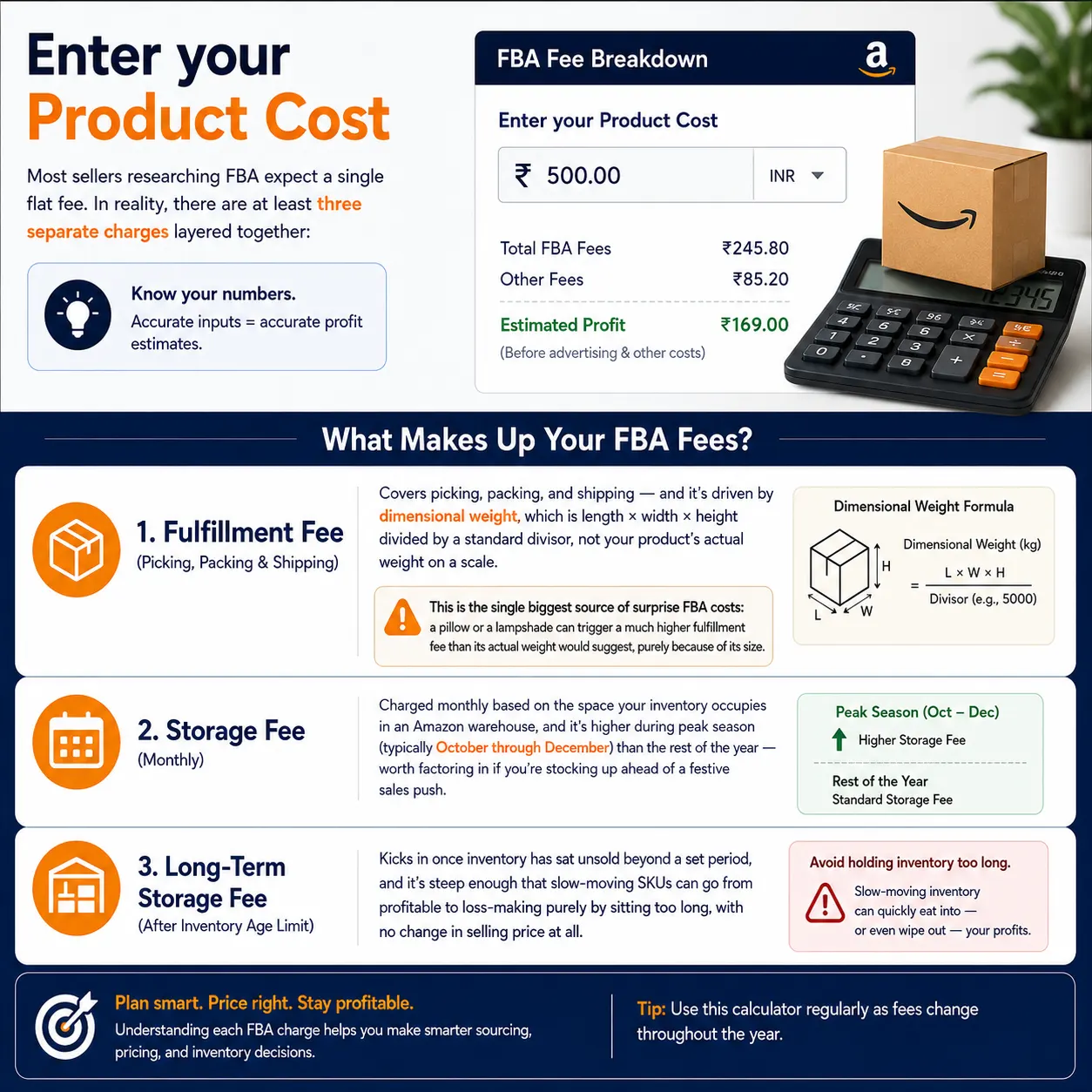
Enter your Product Cost
Most sellers researching FBA expect a single flat fee. In reality, there are at least three separate charges layered together:
The fulfillment fee covers picking, packing, and shipping — and it’s driven by dimensional weight, which is length × width × height divided by a standard divisor, not your product’s actual weight on a scale. This is the single biggest source of surprise FBA costs: a pillow or a lampshade can trigger a much higher fulfillment fee than its actual weight would suggest, purely because of its size.
The storage fee is charged monthly based on the space your inventory occupies in an Amazon warehouse, and it’s higher during peak season (typically October through December) than the rest of the year — worth factoring in if you’re stocking up ahead of a festive sales push.
The long-term storage fee kicks in once inventory has sat unsold beyond a set period, and it’s steep enough that slow-moving SKUs can go from profitable to loss-making purely by sitting too long, with no change in selling price at all.
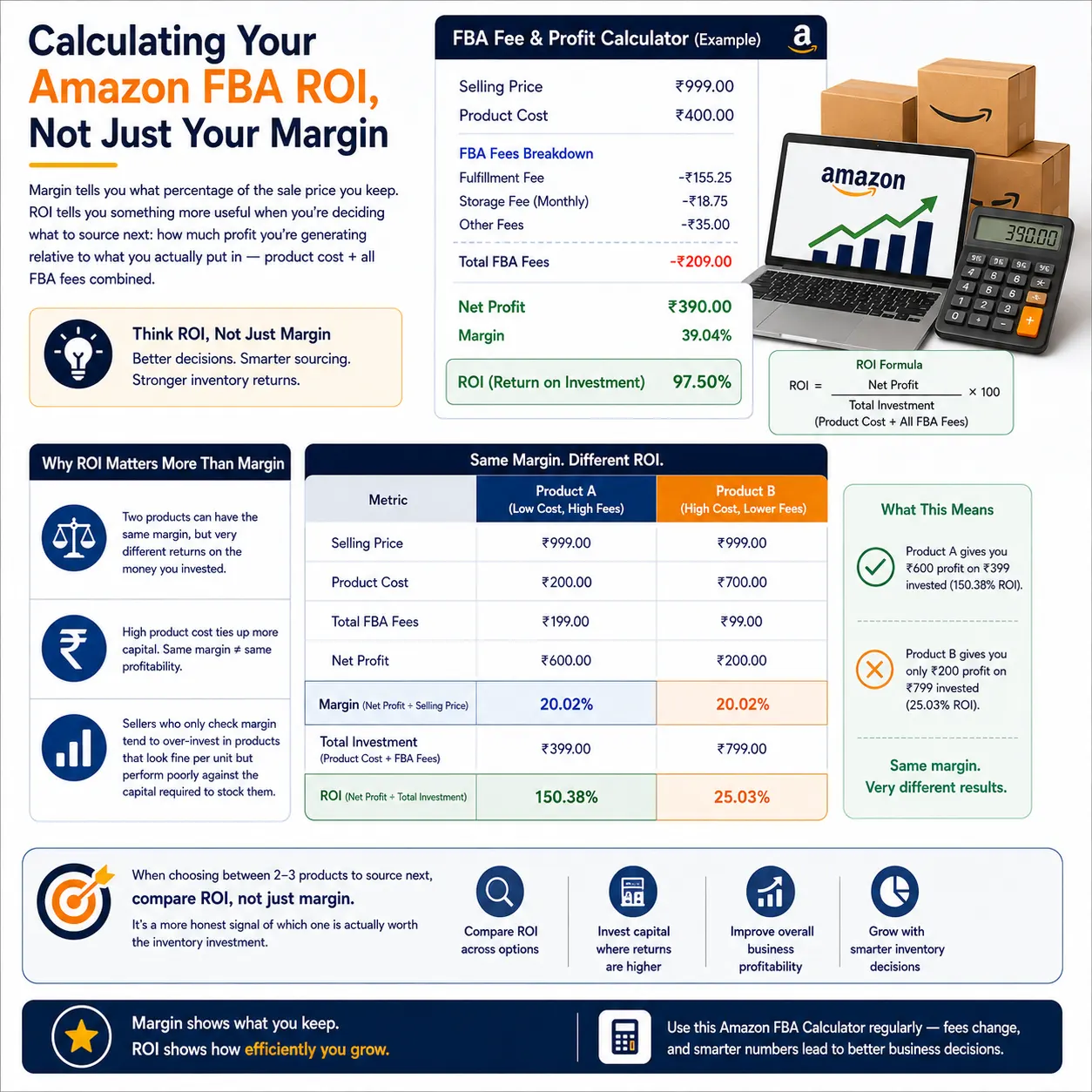
Calculating Your Amazon FBA ROI, Not Just Your Margin
Margin tells you what percentage of the sale price you keep. ROI tells you something more useful when you’re deciding what to source next: how much profit you’re generating relative to what you actually put in — product cost plus all FBA fees combined.
Here’s why that distinction matters in practice. Two products can show the same 20% margin, but one might have a low product cost and high fees, while the other has a high product cost and lower fees. The second product often has a worse ROI even at the same margin percentage, because you’ve tied up more capital to generate the same return. Sellers who only check margin and skip ROI tend to over-invest in products that look fine on a per-unit basis but perform poorly against the capital required to stock them.
If you’re deciding between two or three products to source next, run each through this calculator and compare ROI, not just margin — it’s a more honest signal of which one is actually worth the inventory investment.
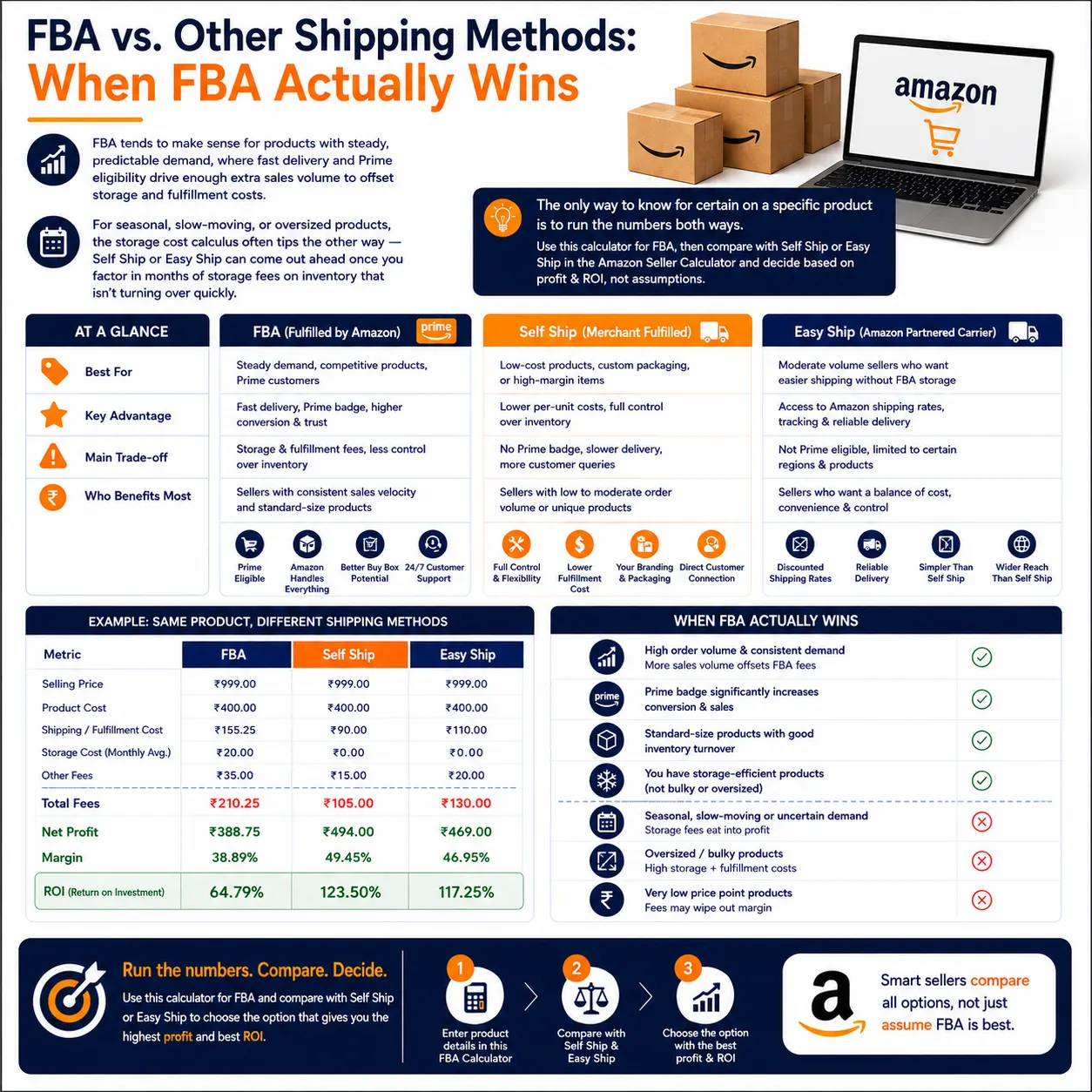
FBA vs. Other Shipping Methods: When FBA Actually Wins
FBA tends to make sense for products with steady, predictable demand, where fast delivery and Prime eligibility drive enough extra sales volume to offset storage and fulfillment costs. For seasonal, slow-moving, or oversized products, the storage cost calculus often tips the other way — Self Ship or Easy Ship can come out ahead once you factor in months of storage fees on inventory that isn’t turning over quickly.
The only way to know for certain on a specific product is to run the numbers both ways. Use this calculator for the FBA scenario, then run the same product through the Amazon Seller Calculator with Self Ship or Easy Ship selected, and compare the final profit and ROI side by side rather than assuming FBA is automatically the better option because it’s more hands-off.
What We Do
Our Services
Everything you need to succeed in e-commerce

Amazon Account Services
Dominate the largest online marketplace with our end-to-end Amazon services — from seller registration and A+ content to PPC campaigns and brand store design that boost visibility and conversions.

Flipkart Account Services
India's homegrown ecommerce powerhouse. We help sellers with account setup, catalogue management, ad campaigns, and pricing strategies to win the Buy Box and drive higher order volumes.

Alibaba Account Services
Expand your B2B reach on the world's largest wholesale marketplace. We handle store setup, mini-site design, keyword-rich listings, and RFQ management to connect you with global buyers.

Myntra Account Services
India's leading fashion marketplace demands pixel-perfect catalogues and brand compliance. We manage brand approval, product shoots, listing QC, and promotional campaigns to maximize your fashion sales.
Frequently Asked Questions
How do I calculate Amazon FBA fees?
FBA fees combine a fulfillment fee (based on dimensional weight, not actual product weight), a monthly storage fee (based on the space your inventory occupies), and a long-term storage fee if stock sits unsold beyond a set period. This calculator adds all three together with your referral fee for a complete cost picture.
What is a good ROI for an Amazon FBA product?
How is Amazon FBA cost different from Amazon seller fees generally?
Does dimensional weight really matter that much for FBA fees?
How can I reduce my Amazon FBA costs?
Is FBA calculator accuracy the same for the USA and India?
What's the difference between using this FBA calculator and the general Amazon Seller Calculator?